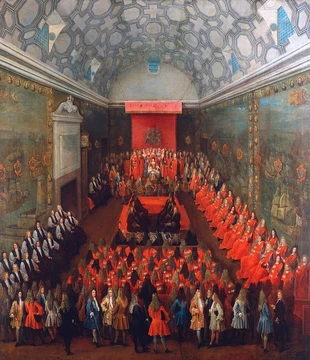
Maria I of Portugal
First undisputed queen regnant of Portugal and Brazil.

Her reign is noted for the dismissal of the powerful Marquis of Pombal, economic growth, and later her mental decline, which led to her son John serving as prince regent.
- field
- Monarchy
- nationality
- Portuguese
- known_for
- First undisputed queen regnant of Portugal; first monarch of Brazil; reign marked by Viradeira and later mental illness
Lore & Background
Maria was the eldest daughter of King Joseph I and Queen Mariana Victoria, born at Ribeira Palace in Lisbon. Educated by Jesuit tutors with a focus on religion and theology, she also learned French and Latin. Her early reign saw the dismissal of the Marquis of Pombal and a partial reversal of his policies, known as the Viradeira. She pardoned over eight hundred prisoners, and her government oversaw economic growth and construction projects such as the completion of the Palace of Queluz. After Brazil was elevated to a kingdom in 1815, she became Queen of the United Kingdom of Portugal, Brazil and the Algarves.
Reader's Guide
Maria I's significance lies in her role as the first undisputed queen regnant of Portugal and the first monarch of Brazil, marking a transition in Portuguese colonial history. Her reign began with a clear break from the authoritarian rule of the Marquis of Pombal, initiating the Viradeira that restored some traditional influences, though she preserved much of the administrative system. Her early years saw economic growth and cultural building projects, but her later mental deterioration—possibly due to porphyria—led to a regency under her son John. Her legacy is complex: remembered as pious and initially capable, but also as 'the Mad' due to her severe melancholia.
Did You Know?
- Maria was the first undisputed queen regnant of Portugal.
- She dismissed the Marquis of Pombal shortly after ascending the throne.
Ascension and the First Undisputed Queen Regnant
Her path to the throne had been secured years earlier when she thwarted Pombal's attempt to bypass her in favor of her son José. Upon ascending, she immediately pardoned over eight hundred prisoners and moved to dismantle Pombal's grip on government. Her early reign saw economic growth in Portugal, and she commissioned major architectural projects including the completion of the Palace of Queluz and the inauguration of the Palace of Ajuda. Though her husband Peter held the nominal title of king alongside her as Peter III, Maria was the driving force of the monarchy.
Faith, Persecution, and the Pombal Conflict
Maria's religious devotion was the defining force of her political identity. This faith put her on a collision course with the Marquis of Pombal, whose secularizing policies and brutal persecution of the Jesuits deeply disturbed her. She had known several of the accused aristocrats and reportedly pleaded with her father on their behalf. Her opposition to Pombal was not merely political but spiritual — she saw his actions as an assault on the Church itself.
Grief, Depression, and the Regency
The final decade of Maria's reign was marked by a cascade of personal losses that shattered her. The cumulative weight of these bereavements drove the queen into a state of clinical depression that effectively removed her from active governance. Her second son John stepped forward as prince regent, managing the affairs of state while his mother withdrew into a private world of grief and prayer. The three surviving children — José, John, and Mariana Vitória — had been the emotional center of her life after the loss of three infants and two late miscarriages.
The Great Relocation and a Dual Legacy
This extraordinary migration transformed the geopolitical landscape of the Atlantic world. In 1815, Brazil was elevated from colony to kingdom, and Maria became Queen of the United Kingdom of Portugal, Brazil and the Algarves — a title that made her the first monarch of Brazil in its own right. History remembers her by two contrasting epithets: Maria the Pious in Portugal, reflecting her deep Catholic devotion and lifelong advocacy for the Church, and Maria the Mad in Brazil, a reference to the depression and mental deterioration that consumed her final years. Both names capture halves of a woman who reshaped two kingdoms through faith, loss, and an act of extraordinary survival.
Frequently Asked Questions
What role does Maria I of Portugal hold?
As an absolute queen regnant, she exercised full sovereign authority over the Portuguese crown and its Brazilian territories in her own right, without requiring a consort or male heir to validate her rule.
Why is Maria I of Portugal important in the canon?
She broke the long tradition of male-only succession in Portugal, oversaw the dramatic dismissal of the Marquis of Pombal, and presided over a period of notable economic growth before her tragic decline.
More in Monarchs And Nobility 25-29
Elsewhere in the Monarchs And Nobility universe
Spotted an error? Know more?
This is a living reference — every entry is fact-audited, and reader corrections feed straight into our audit queue. Suggest an edit · See this site's audit record