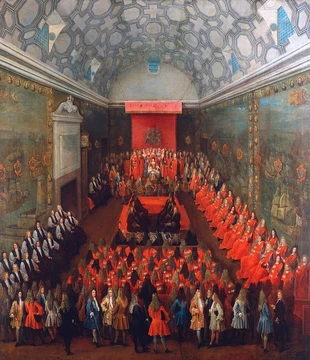
James II of England
Last Catholic monarch deposed in the Glorious Revolution.

The last Catholic monarch of England, Scotland, and Ireland, his reign was marked by conflicts over religion, absolutism and the divine right of kings; his deposition ended a century of political and civil strife by confirming the primacy of the English Parliament over the Crown.
- field
- Monarchy
- nationality
- English, Scottish, Irish
- known_for
- Last Catholic monarch of England, Scotland, and Ireland; deposed in the Glorious Revolution
Lore & Background
However, the trauma of the brief republican Commonwealth of England 25 years earlier made the public reluctant to undermine the principle of hereditary succession. At the age of 51, James therefore succeeded to the throne with widespread support following the death of his elder brother, Charles II, with many believing that a Catholic monarchy would be temporary. However, tolerance of James's personal views did not extend to Catholicism in general, and both the English and Scottish parliaments refused to pass measures viewed as undermining the primacy of the Protestant religion. His attempts to impose them by absolutist decrees, as a matter of his perceived divine right, were met with opposition. Firstly, the birth of James's son and heir James Francis Edward Stuart on 10 June raised the prospect of a Catholic dynasty, displacing his Protestant daughter Mary, who had been heir presumptive. Secondly, the state prosecution of the Seven Bishops was seen as an assault on the Church of England, and their acquittal on 30 June destroyed his political authority. Ensuing anti-Catholic riots in England and Scotland led to a general feeling that only James's removal could prevent another civil war. Leading members of the English political class invited William of Orange, James's nephew and son-in-law, to assume the English throne.
Reader's Guide
James II and VII's significance lies in his role as the last Catholic monarch of England, Scotland, and Ireland, and the catalyst for the Glorious Revolution, which permanently established the supremacy of Parliament over the Crown. His deposition ended a century of political and civil strife by confirming the principle that sovereignty derived from Parliament, not birth. While contemporary opponents often portrayed him as an absolutist tyrant, some 20th-century historians have praised James for advocating religious tolerance, although more recent scholarship has tended to take a middle ground between these views. His reign and exile shaped the Jacobite movement and the subsequent succession of William and Mary, ensuring a Protestant monarchy.
Did You Know?
- He served in the French army under Turenne against the Fronde and later against their Spanish allies.
- His wife Anne Hyde was the daughter of Edward Hyde, 1st Earl of Clarendon, making her a member of the nobility, and their marriage caused controversy at court.
The Road to the Throne
In the 1660s, his conversion to Catholicism became a political flashpoint. When Charles II died, James, then fifty-one, ascended with broad popular backing. Many assumed his Catholic rule would be brief, a temporary interlude before a Protestant heir took the crown.
The Crisis of 1688
On 10 June, the birth of his son and heir, James Francis Edward Stuart, transformed a personal religious question into a dynastic one: a Catholic line of succession now loomed, displacing his Protestant daughter Mary as heir presumptive. Days later, the state prosecution of the Seven Bishops—perceived as a direct assault on the Church of England—culminated in their acquittal on 30 June, an event that effectively destroyed James's remaining political authority. Anti-Catholic riots erupted across England and Scotland, and a widespread conviction took hold that only his removal could avert another civil war. In response, leading figures in the English political establishment extended an invitation to William of Orange, James's nephew and son-in-law, to claim the throne. When William's fleet touched down at Brixham on 5 November, James's own army deserted him. By 23 December, he had fled to France, leaving his crown behind.
The Irish Gambit and Final Defeat
His arrival coincided with a simultaneous rising in Scotland, suggesting that a meaningful portion of his former subjects still rallied to his cause. Yet the political tide had turned decisively. In April of that same year, a Scottish Convention followed England's lead, declaring that James had forfeited the throne and offering it to William and Mary. With no remaining base of power and no realistic prospect of reconquest, he returned to France for the final time.
Legacy and the Question of Sovereignty
By declaring that James had vacated the throne and installing William and Mary as joint sovereigns, Parliament established the foundational principle that legitimacy derived not from birthright alone but from parliamentary consent. This act effectively ended a century of political and civil strife and confirmed the primacy of the English Parliament over the Crown. As the last Catholic monarch to rule England, Scotland, and Ireland, James remains a polarizing figure in historical memory. His contemporary opponents cast him as an absolutist tyrant who wielded the divine right of kings to impose his will. Some twentieth-century scholars, by contrast, have credited him as a genuine advocate of religious tolerance. More recent scholarship has tended to occupy a middle ground, acknowledging both his sincere commitment to pluralism and his willingness to use royal prerogative in ways that provoked legitimate resistance.
Frequently Asked Questions
What were James II's powers and role as king?
He governed as an absolute monarch who invoked the divine right of kings, believing his authority derived directly from God. His attempts to rule without meaningful parliamentary input and to place Catholics in positions of power put him at odds with the Protestant establishment.
Why is James II of England important?
His overthrow cemented the principle that Parliament holds ultimate authority over the Crown, bringing an end to roughly a century of religious and civil conflict. He is also a landmark figure as the final Catholic monarch of the British kingdoms.
What was James II known for?
He is most recognized as the last Catholic sovereign of England, Scotland, and Ireland. His reign became a defining flashpoint in the long struggle between royal absolutism and parliamentary power.
More in Monarchs And Nobility 1-24
Elsewhere in the Monarchs And Nobility universe
Spotted an error? Know more?
This is a living reference — every entry is fact-audited, and reader corrections feed straight into our audit queue. Suggest an edit · See this site's audit record