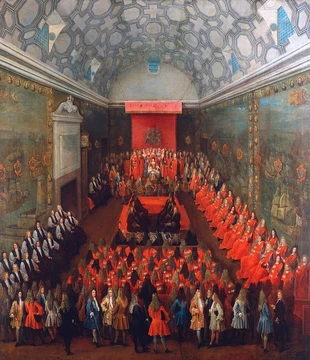
Joseph I, Holy Roman Emperor
Holy Roman Emperor who continued the War of the Spanish Succession.

He was the eldest son of Leopold I, Holy Roman Emperor from his third wife, Eleonor Magdalene of Neuburg. Joseph continued the War of the Spanish Succession begun by his father and, through victories by Prince Eugene of Savoy, established Austrian hegemony over Italy. He also faced a protracted revolt in Hungary and pursued administrative reforms, though neither major conflict was resolved until after his death.
- field
- Monarchy, military leadership
- nationality
- Habsburg (Holy Roman Empire)
- known_for
- Continuing the War of the Spanish Succession; establishing Austrian hegemony in Italy; administrative reforms; anti-Romani edicts
Lore & Background
Born in Vienna, Joseph was educated strictly by Charles Theodore, Prince of Salm, and became a good linguist. He was a less devout Catholic than his parents and developed into an adherent of the early Age of Enlightenment. He had two great enthusiasms: music and hunting. At age nine he was crowned King of Hungary, and at eleven King of the Romans. Prior to his ascension, Joseph surrounded himself with reform-hungry advisors and was described as a forward-looking ruler. He reduced the number of privy councillors, made the bureaucracy more efficient, and stabilized Habsburg finances. In Hungary, he inherited the kuruc rebellion but agreed to a compromise peace, reversing many authoritarian measures of his father. Joseph's government faced religious and ethnic challenges during Rákóczi's rebellion. He confirmed religious liberties for Eastern Orthodox subjects and the Metropolitanate of Krušedol. His marriage to Wilhelmine Amalia of Brunswick-Lüneburg produced three children, but only one son died in infancy; a sexually transmitted disease rendered his wife sterile.
Reader's Guide
Joseph I's significance lies in his continuation of the War of the Spanish Succession, which, through the military successes of Prince Eugene of Savoy, secured Austrian dominance in Italy. His reign also saw administrative modernization and a more conciliatory approach to the Hungarian rebellion, which facilitated the eventual integration of Hungary into Habsburg domains. However, his legacy is marred by the brutal edicts against the Romani, ordering mutilation and execution. His failure to produce a male heir led to the Mutual Pact of Succession, which later contributed to the War of the Austrian Succession. Joseph's reign, though short, marked a transition toward Enlightenment-influenced governance within the Habsburg monarchy.
Did You Know?
- Joseph was crowned King of Hungary at age nine and King of the Romans at age eleven.
- He caught a sexually transmitted disease, probably syphilis, which rendered his wife sterile.
Frequently Asked Questions
What were Joseph I's powers and role?
As Holy Roman Emperor he wielded supreme authority over the Habsburg lands and the wider imperial framework. In practice he directed military strategy in the War of the Spanish Succession and drove domestic administrative modernization across the monarchy.
Why is Joseph I, Holy Roman Emperor important?
He carried on his father's War of the Spanish Succession and, through Prince Eugene of Savoy's campaigns, locked in Austrian dominance over Italian territories. He also advanced bureaucratic and administrative reforms, though the protracted Hungarian revolt was not quelled until after his death.
What is Joseph I most known for?
Fans and historians most associate him with continuing the War of the Spanish Succession and cementing Habsburg hegemony in Italy. He is also remembered for sweeping administrative reforms and, more controversially, for issuing anti-Romani edicts during his short reign.
More in Monarchs And Nobility 1-24
Elsewhere in the Monarchs And Nobility universe
Spotted an error? Know more?
This is a living reference — every entry is fact-audited, and reader corrections feed straight into our audit queue. Suggest an edit · See this site's audit record