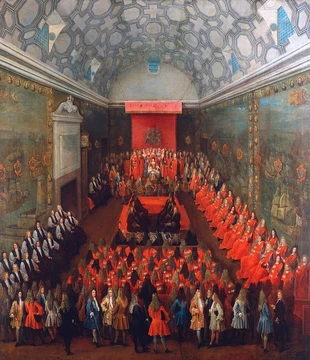
Johann II of Liechtenstein
Prince of Liechtenstein for 70 years; issued two constitutions.

His reign of 70 years and 91 days is among the longest precisely documented reigns of any sovereign monarch in European history, and is the second-longest overall among those with exact dates known.
- known_for
- Longest-reigning European monarch (second among those with exact dates); issued first and second constitutions of Liechtenstein; patron of the arts
Lore & Background
Johann II was the elder son of Aloys II, Prince of Liechtenstein and Countess Franziska Kinsky of Wchinitz and Tettau. He ascended to the throne shortly after his 18th birthday. Johann II was an outstanding art connoisseur and generous patron, adding much to the Liechtenstein Princely Collections. He was unsociable, rarely appearing at his Vienna residences, and never assumed tasks in Austrian politics or military. He never married or had children. Though he spent most of his time on Austrian and Moravian estates, he did occasionally reside in the principality, particularly at Vaduz Castle.
Reader's Guide
Johann II's significance lies in his exceptionally long reign and his role in transforming Liechtenstein from an absolute monarchy into a constitutional one. His foreign policy shift away from Austria-Hungary toward Switzerland, culminating in a customs union and adoption of the Swiss franc, set the principality on a path of neutrality and economic integration. As a patron of the arts, he enriched the Princely Collections and restored family castles, though his reclusive nature kept him from public life. His reign, the third-longest in European history, ended without direct heirs, passing to his brother.
Did You Know?
- Johann II's reign of 70 years and 91 days is the second-longest of any sovereign monarch in European history with exact dates known.
- He never married or had children, but did occasionally reside in the principality of Liechtenstein, particularly at Vaduz Castle.
Early Life and Military Formation
His uncle took him under his wing, and the boy accompanied Joseph Wenzel on a military campaign through Northern Italy. There, at the Battle of Piacenza, the young heir fought alongside his uncle in a victory for the Holy Roman Empire, the political entity of which Liechtenstein was a part. This early exposure to warfare and imperial politics shaped a man who would spend the next four decades moving through the corridors of Habsburg power before finally assuming the title he had been promised since childhood.
Imperial Service and Chivalric Honors
Before he ever sat on the Liechtenstein throne, Franz Josef built a distinguished career in the service of the Habsburg Emperor. These roles reveal a man deeply embedded in the administrative and ceremonial machinery of the empire, a position that would prove invaluable when he inherited the small Alpine principality just two years after his last office.
Reign and Cultural Stewardship
His reign, though brief, was marked by a keen attention to the practical and cultural needs of his small territory. He devoted considerable energy to addressing the principality's economic difficulties, a persistent challenge for a landlocked state of modest size. Simultaneously, he turned his attention to the Liechtenstein art collection, which was steadily growing during his tenure, and he showed genuine enthusiasm for its expansion and stewardship. In just under a decade of rule, he left behind a principality with its economic concerns acknowledged and an art collection that would continue to grow under his successors.
Marriage and Dynastic Legacy
Together they raised eight children, a family that would extend the Liechtenstein line across several generations and into other prominent European houses. Two sons, Joseph Franz and Franz de Paula, died in infancy, a sobering loss. His daughters forged important alliances: Leopoldina married Karl Emanuel, Landgrave of Hesse-Rheinfels-Rotenburg, while Maria Josepha became the wife of Nikolaus, the 7th Fürst Esterházy von Galántha. One daughter, Maria Antonia, took holy orders as a nun.
Frequently Asked Questions
How long did Johann II of Liechtenstein reign?
His tenure lasted 70 years and 91 days, placing it among the longest precisely documented reigns of any European sovereign. Among monarchs with exact start and end dates on record, it ranks as the second-longest overall.
What are Johann II of Liechtenstein's key achievements?
He is credited with introducing both the first and second constitutions of Liechtenstein, which fundamentally reshaped the principality's system of governance. He was also a noted patron of the arts throughout his decades on the throne.
Why is Johann II of Liechtenstein important to fans of monarchs and nobility?
His extraordinary length of rule makes him a go-to reference in discussions about the most enduring European sovereigns. His dual constitutional reforms also give him a distinctive place in the political evolution of small European states.
More in Monarchs And Nobility 1-24
Elsewhere in the Monarchs And Nobility universe
Spotted an error? Know more?
This is a living reference — every entry is fact-audited, and reader corrections feed straight into our audit queue. Suggest an edit · See this site's audit record